


There’s a saying on Wall Street:
“They don’t ring a bell at the top.”
That’s true. They don’t.
They didn’t in the dotcom bubble, when thousands of professional investors and analysts (including me) were listening and failed to hear it.
They didn’t at the top of the housing or SPAC bubbles.
And they won’t at the top of the AI bubble.
But, in all market cycles, investors and executives (including me) recall in hindsight that there were “bells” they heard and wish they had paid more attention to. Because, at the very least, these signals warned that conditions were changing.
This weekend (in my opinion) we got another loud warning that AI conditions are changing.
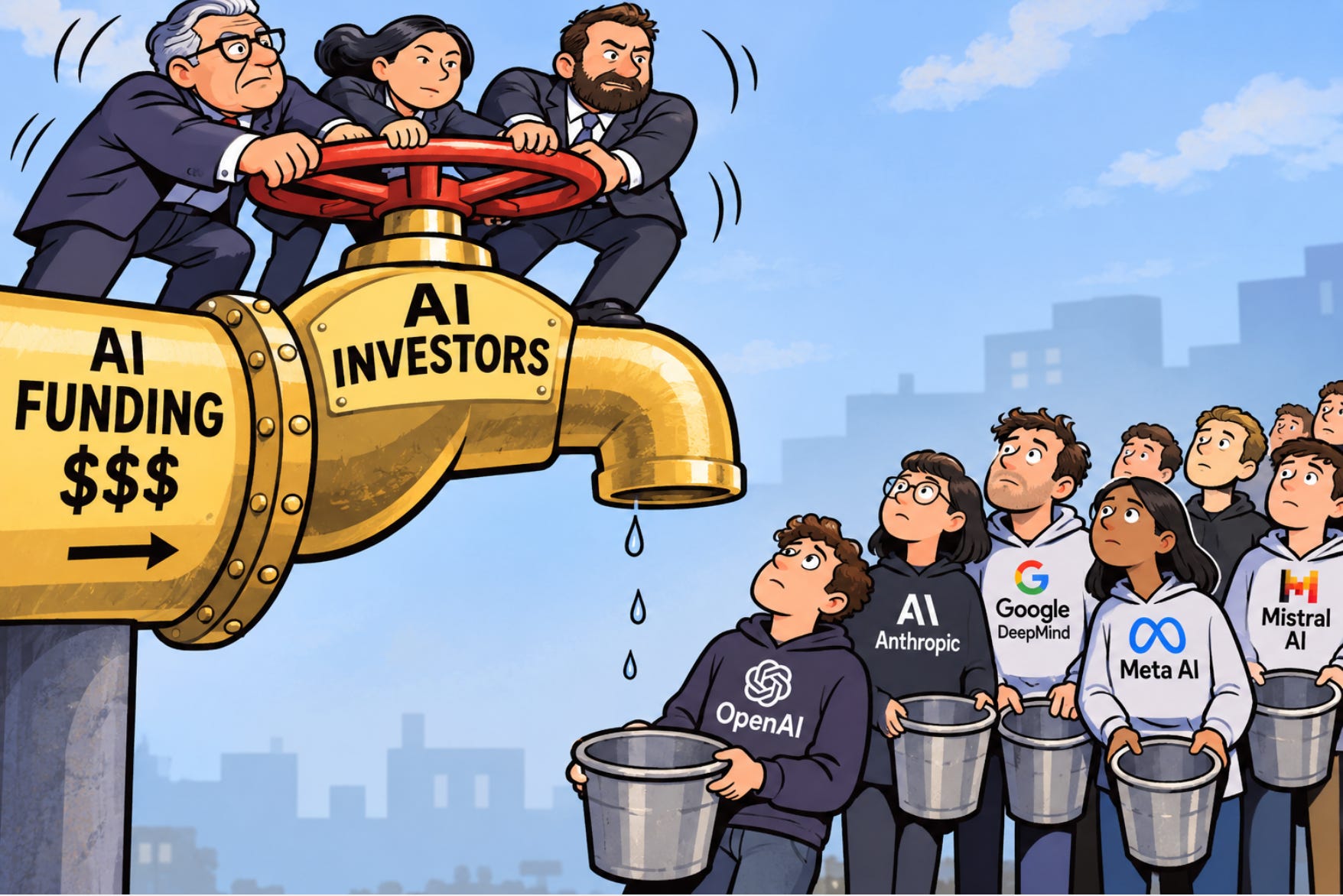
The former market leader, OpenAI, has reportedly raised less than half of the money it wanted to raise in its latest round. And at a lower valuation.
Specifically, reports the Wall Street Journal’s Berber Jin, OpenAI has only secured commitments for $11 billion of a $30 billion target. And it has reduced the valuation to $1.25 trillion from $1.4 trillion.
OpenAI screwed up and lost its lead to Anthropic, so investors are understandably cautious. But other signs suggest the tightening of the AI money spigot isn’t just an OpenAI thing.
To wit:
Last week, investors gave Bronx cheers to Meta, Amazon, Google, and others that said they were going to continue to ramp already colossal AI infrastructure investments. The message? “Enough.”
Investors dumped bonds of neo-cloud providers CoreWeave, Nebius, et al, forcing the companies to pay more to borrow the cash they need. Again, “Enough.”
Neo-cloud provider Nscale postponed its IPO and Lambda (another) cut the price of a private round, according to this comprehensive round-up from the WSJ’s Peter Rudegeair, Robbie Whelan, and Jack Pitcher.
“What can’t go on forever… won’t”
There’s another Wall Street saying. “If something can’t go on forever, it won’t.” That one’s also true.
AI companies like Anthropic and OpenAI can’t continue to grow at astronomical rates forever.
Hyperscalers can’t continue to burn and borrow hundreds of billions forever.
And investors can’t continue to pay “whatever” for AI investments forever. Because, eventually, price does matter. If you pay too much, you have a very low probability of generating a sufficient return.
None of these things can go on forever. And they won’t.
The AI money-spigot is tightening
There are two components of any market bubble (or smaller cycle):
Demand for (and supply of) the thing that everyone’s going crazy about, and
Money to pay for it
In the mortgage boom, borrowing criteria eventually got so loose that anyone who wanted a house could get it. In the dotcom boom, investor demand got so intense that anyone with a decent business plan could fund it.
These torrents of cash paid for huge demand (and supply).
Eventually, however, the spigots shut off, and the bubbles burst.
The warnings we’ve heard over the past week on the “money” side of the AI bubble follow a loud one on the demand side. Anthropic’s sharp slowdown in Q3 was a reminder that demand for AI services won’t be infinite.
So, no, they won’t ring a bell at the top.
And no one will know for sure when we’ve reached the top.
But no one should be surprised if what is happening now proves to be the top. Because this is what the top will look (and sound) like.
See Also: