


As is often the case in the early buildout phase of new technologies, a fierce argument is raging about whether the AI spending boom is rational investment or a speculative bubble.
The answer, very likely, is… both.
AI is a profound new technology that will radically change the economy and society — just as the Internet, computers, cars, trains, canals, electricity, and other technologies did.
And…
Much (most?) of the money being invested right now will probably be lost — just as much of the money invested early in the prior booms was.
Yes, it’s possible that AI is such a colossal and unprecedented opportunity that what’s happening now is not a bubble, and the AI boom will never turn to bust.
But that doesn’t seem likely.
More likely, the early AI boom will end the way most prior eras have ended — with a gigantic bust that clobbers most early companies and investors… followed by a long boom that helps build huge new companies and wealth and radically changes society.
Personally, I hope there’s never an AI bust — because it will hurt millions of people, including me. AI investment accounts for such a huge amount of U.S. economic growth (a third, by some estimates) that an AI bust will likely trigger a bear market in stocks and a major recession. I don’t run an AI company or trade frequently, but I do own stocks and benefit from a healthy economy. So, if there’s an AI bust, I’ll get poleaxed along with everyone else.
But having had a front-row seat for two big booms-and-busts — the Internet (1995-2002) and the Great Financial Crisis (2002-2009) — I’m fascinated by the parallels (and differences) with this one. So, while I hope the AI boom will never turn to bust, I will also keep analyzing outloud.
All the posts on this topic are free. I hope you find them helpful. I also hope you’ll share some of your own thinking, research, and data with me as we go (just hit reply). The “wisdom of the crowd” is real. We make each other smarter.
Growth and leverage — we’ve got ‘em!
Most speculative bubbles share two key elements:
An exciting new innovation or product that leads to enormous demand (“Growth”)
And
Debt, credit, circular financing, or other leverage that amplifies this demand (“Leverage”)
In the Internet bubble, the growth was real. Millions of new people connected every month, and usage went through the roof. For five years, insatiable demand drove astonishing fundamental growth at dozens of companies. (Amazon, AOL, Yahoo, Exodus, Level 3, Worldcom, Cisco, Juniper, etc.)
The “leverage” was also clear — especially in hindsight. Companies borrowed hundreds of billions of dollars to build out telecom networks and buy computers and networking gear. And Internet service providers raised tens of billions in equity investments.
For five years, these factors combined to produce one of the biggest tech booms the world had ever seen (which pales in comparison to the AI one).
But by 2000, the supply of Internet products and services finally caught up with demand, rising interest rates raised the cost of borrowing, and hundreds of IPOs and follow-on offerings sated demand for Internet investments…
The music stopped.
Growth slowed.
And leverage reversed.
Similarly, in the years leading up to the Great Financial Crisis, low interest rates and mortgage innovation (low/no-doc, low/no downpayment, subprime, etc.) fueled an extraordinary housing boom. But by 2008, there were no more lending standards to relax, returns for lenders and investors plunged, stretched borrowers could no longer make payments, and everyone who wanted houses had them.
Demand and leverage dropped. Once again, it was “look out below.”
AI companies are growing faster than any in history.
Do we have astonishing growth (demand) and leverage in the AI boom?
You bet we do.
Those dismissing the AI boom as a hallucination got a rude awakening this spring when word of Anthropic’s otherworldly growth began to spread.
Anthropic’s new coding tool ignited spectacular demand, and its revenue exploded to $4.8 billion in Q1. Q2 revenue more than doubled sequentially, to $11.6 billion. According to Bloomberg, based on July’s results, Anthropic is now generating an astonishing $65 billion in annualized revenue (July revenue X 12). That’s up a breathtaking 7X from last year.
No company in history that I know of has ever grown like that.
The Wall Street Journal also reports that Anthropic is now profitable. This nukes the previous (widespread) naysaying that AI economics don’t work and the leading model companies “can’t make money” and will go bankrupt. Anthropic may not stay profitable. But it is now.
Even OpenAI, which lost focus and fumbled its early industry lead, is now reportedly doing $40 billion of annualized revenue. That may not be apples-to-apples accounting with Anthropic, but it’s still a colossal number.
Despite its revenue growth, OpenAI, in my view, is on track to become the Netscape of the AI era: The company that kicked off the boom and, for a brief moment, became synonymous with it… but then missed a turn and failed.
OpenAI’s sequential growth slowed radically in Q2. Revenue was up “only” 18%, to $6.7 billion from $5.7 billion in Q1, the WSJ reports. This is the equivalent of a race car screeching off the track while another car blows past.
Anthropic’s spectacular growth must be sending shock waves of alarm through the OpenAI community. But the growth of both companies shows that underlying user demand for AI is astonishing.
The question now is how long Anthropic’s growth can continue like this.
If Anthropic’s run-rate is $65 billion now, it will likely be $100 billion by early next year. This makes the company’s recent valuation of nearly $1 trillion look downright reasonable.
The global market for enterprise software spending — the primary source of this revenue — is estimated to be $1.4 trillion, so there would seem to be plenty of room for growth in this segment alone.
Beyond that, Anthropic will have to penetrate new segments to keep the growth going.
Leverage, meanwhile, is everywhere
Many have noted the jaw-dropping amounts that investors and companies are shoveling into AI-related projects. The Internet boom looks like penny-poker in comparison.
The tech giants — Alphabet, Meta, Amazon, et al — have gone from generating tens of billions of dollars of free cash flow every year to investing so much in AI infrastructure that they’re burning cash.
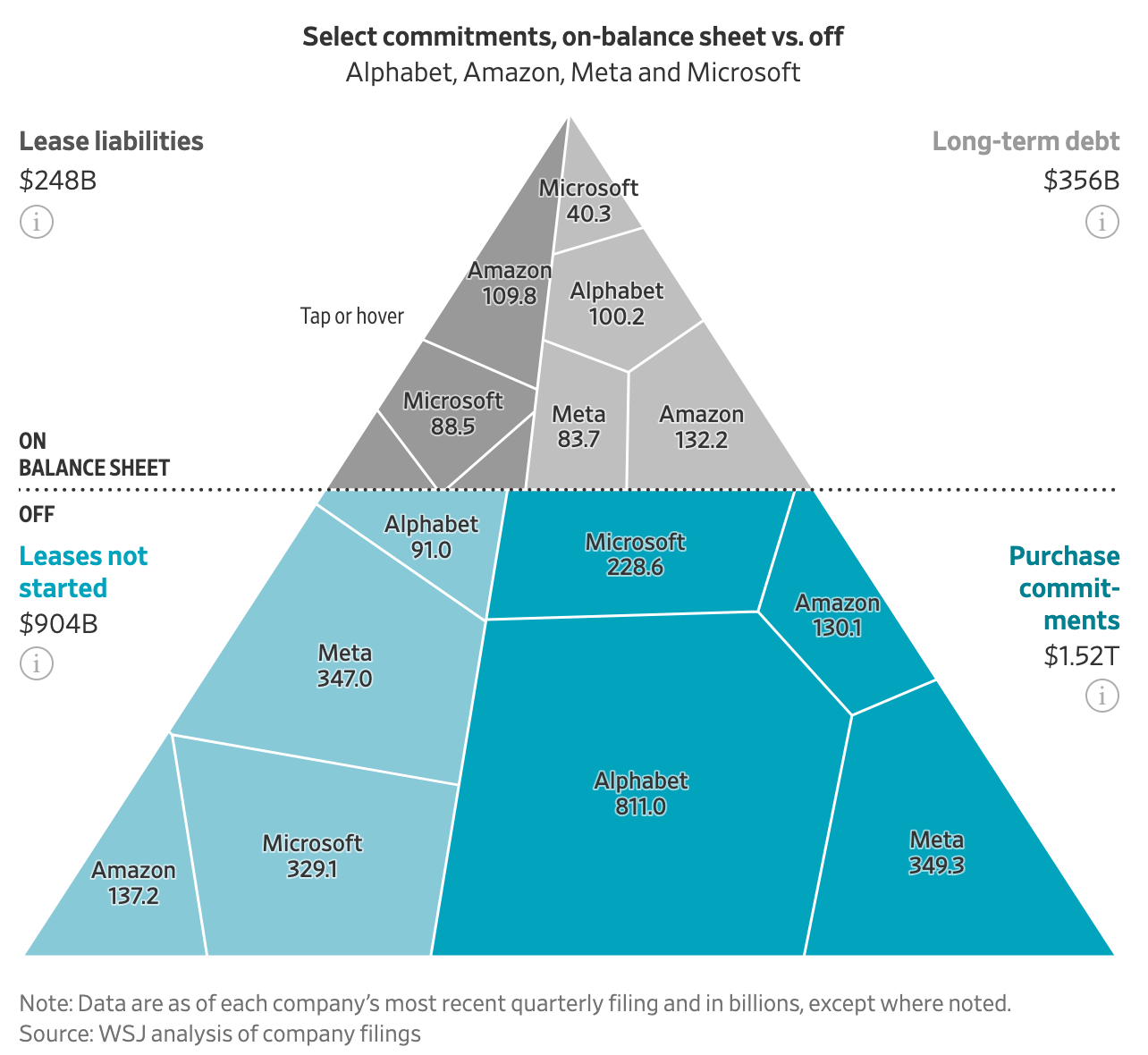
Moreover, as this excellent article in the Wall Street Journal highlights, these companies (and others) are making far larger future spending and investment commitments than their current financial statements suggest.
As just one example, according to the WSJ, Alphabet’s “off balance sheet” commitments increased by almost $500 billion in the past three months alone.
$500 billion!
Last year, Alphabet generated about $25 billion of free cash flow per quarter, or about $100 billion a year. Even at that rate, it would take Alphabet 5 years to pay off the commitments it has made in the past 3 months. But Alphabet is no longer generating any cash. In Q2, for the first time in its history as a public company, it burned cash.
Alphabet does, at least, have the capacity to generate cash through its own operations. Investors who have to borrow cash to make AI investments don’t.
Then there are the much-publicized “circular” financing deals.
For example, chip-maker Nvidia just announced an agreement to invest $1.5 billion and provide a credit backstop of $105 billion in the buildout of a giant Ohio data center. The data center owner will presumably use some of that money to buy Nvidia chips. Separately, Nvidia has agreed to invest $30 billion into OpenAI, which will use some of that cash to lease the data center.
This vendor financing and investment isn’t sleazy or illegal. But it takes the cash and borrowing capacity of Nvidia and turns it into financing for future purchases of Nvidia chips. And it allows OpenAI and other AI providers to buy far more chips and compute than they would without the financing.
In short, it’s leverage. And it amplifies and supports demand for the whole AI ecosystem.
Someday…
Unless the AI boom truly is different — unless the end-user demand for AI services is so insatiable that demand remains ahead of supply forever (which it won’t) — we know how it will end.
Someday, AI supply will catch up with demand and AI financing leverage will max out. And/or another trigger, like rising global interest rates, will make investors and executives more cautious about making such enormous long-term commitments.
That day may be many years in the future. Or it may already be here.
A debate among Internet veterans is where we are in the cycle — say, 1997 or late 1999. If we’re only in 1997, the early AI investment boom is just getting rolling. If we’re in late 1999, we’re Wile E. Coyote sprinting in mid-air after running off a cliff.
One of the lessons of both the Internet boom/bust and the Great Financial Crisis is that you can be almost certain the phenomenon is a bubble and still miss the top.
This is true not just for casual observers (or then-young analysts like me) but for the best investors and executives on the planet.
Just ask Stan Druckenmiller and dozens of other brilliant and experienced investors who held on too long in 2000.
Or all the bank CEOs who levered up to buy too many risky mortgages in the early ‘00s and steered their ships into disaster.
These folks weren’t blind or stupid. They knew everything that could be known, including that the Internet and housing booms were probably bubbles. And they still blew it.