


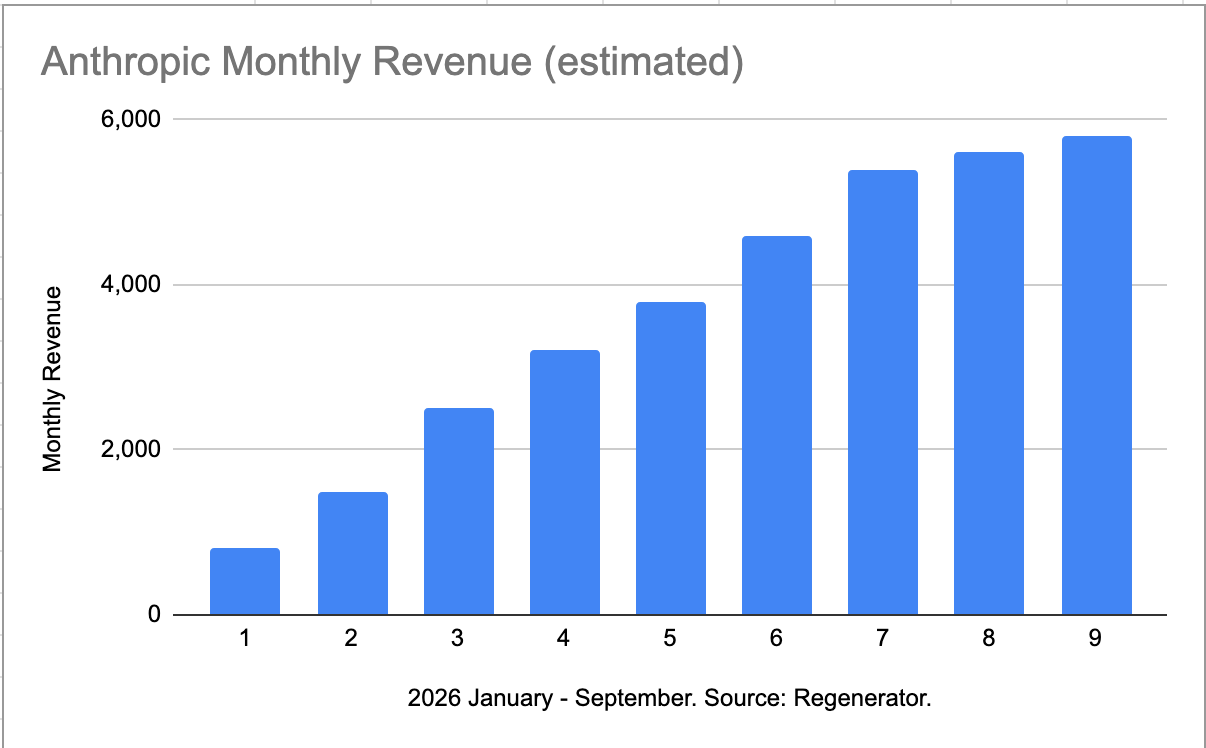
Anthropic shared high-level Q3 financials with investors yesterday, report the NYT’s Andrew Ross Sorkin, Lauren Hirsch, and Sri Muppidi.
Revenue for Q3 was reportedly $16.8 billion.
At first glance, this number seems astonishing. And, in one sense, it is. It’s another jaw-dropping sequential gain for what is likely the fastest-growing company in history.
But, break the trend down into implied monthly growth, and the picture looks different.
Specifically, it seems Anthropic barely grew from July to September.
Anthropic’s sequential revenue growth in Q3, moreover, was smaller in absolute dollars than its (gobsmacking) growth in Q2.
So, for several possible reasons, Anthropic’s growth has meaningfully slowed.
This is likely another reason why the stocks of “neocloud” providers like CoreWeave are collapsing. CoreWeave, et al, have borrowed tens of billions of dollars on the assumption that demand for AI compute will continue to grow at rates way beyond consensus expectations for years.
Now, not only are interest rates soaring — raising the carrying costs of this debt — the near-term revenue growth for AI services may be flattening.
Analyzing Anthropic’s growth…
Anthropic’s reported revenue growth this year has been unprecedented:
Q1: $4.8 billion
Q2: $11.6 billion (+$6.8B and +141%, sequentially)
Q3: $16.8 billion (+$5.2B and +45%, sequentially)
Again, these numbers are astonishing.
But so are AI valuations and expectations.
Note that Anthropic added more revenue in Q2 than it did in Q3.
Note, too, that what matters most for Anthropic’s IPO valuation — and, likely, for the future trajectory of the AI bubble — is not what has happened but what will happen.
The key question is, “What do these numbers suggest about how fast Anthropic will grow from here?”
These figures suggest that the market should temper its expectations, at least temporarily.
If we break down the quarterly figures above into monthly estimates and add one more reported data point — that Anthropic had a $65 billion annualized revenue run-rate in July — we see that Anthropic’s growth has flattened even more than the quarterly figures suggest.
Below are back-of-the-envelope estimates for Anthropic’s monthly revenue in 2026. They are based on the reported quarterly revenue figures as well as the $65 billion annualized revenue in July (which equates to ~$5.4 billion of July revenue).
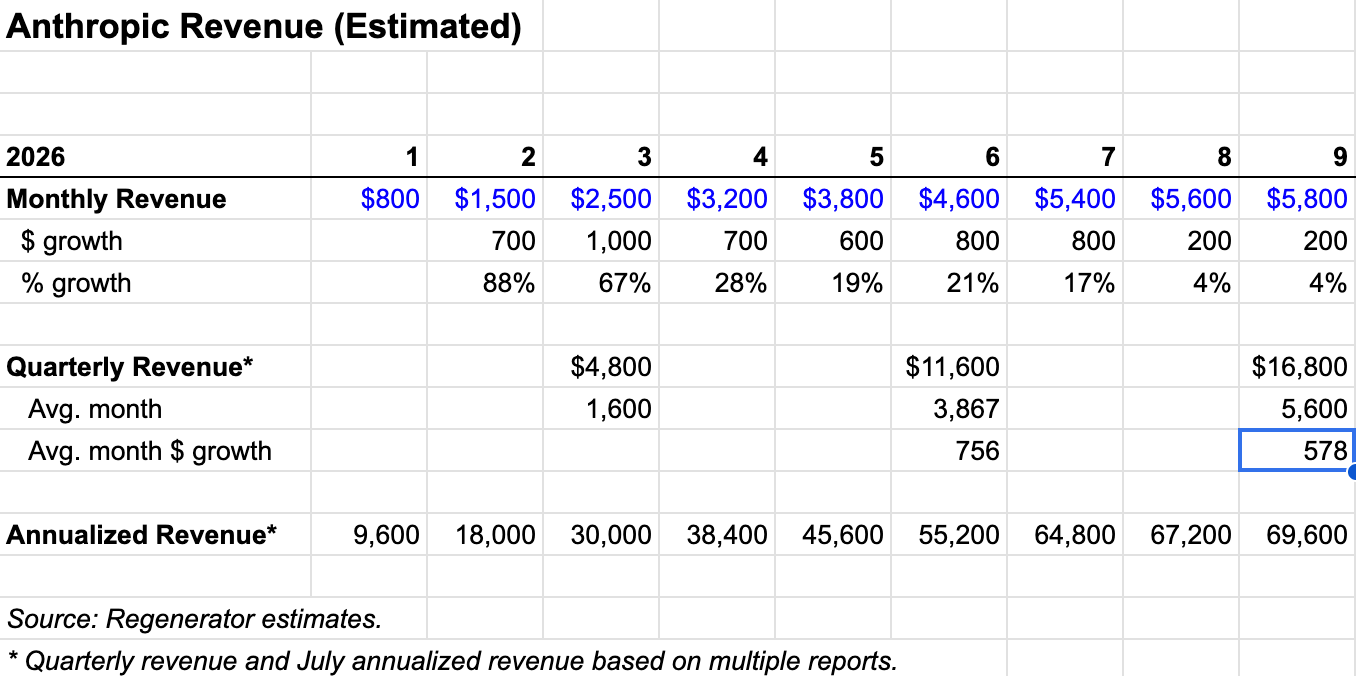
Even the quarterly numbers suggest that Anthropic’s average monthly growth slowed from ~$760 million in Q2 to (“only”) $580 million a month in Q3.
But the “$65 billion annualized revenue in July” data point suggests the slowdown is even sharper.
If Anthropic did $5.4 billion in revenue in July and $16.8 billion in Q3, it likely only grew modestly in August and September.
According to DealBook, at its meeting with investors yesterday, Anthropic did not share an annualized revenue number based on September’s revenue. This suggests — to this analyst, anyway — that Anthropic did not think the September annualized revenue figure would show impressive-enough growth versus July.
Indeed, when we extrapolate the monthly figures, it seems Anthropic saw a sharp change in its growth trajectory in August and September.
What does this mean?
It means that the growth of the leading company in the sector appears to have slowed sharply in the past two months.
The slowdown might at least in part be the result of seasonality. August, at least, tends to be a slow month. But it’s early in a product cycle to see such sharp seasonality. And September’s growth should have sped back up.
It might also mean that Anthropic is simply not able to keep up with the growth of demand. If this is the reason for the slowdown, it’s a high-quality problem, and it won’t have a long-term impact on the overall AI spending growth trajectory (or bubble).
But it may also mean that the near-term growth rate of AI spending is moderating — either because demand growth is moderating or because companies are using cheaper models from China for some of their AI needs. (Usage data suggests the latter is in fact happening).
If a slowdown in spending growth is the explanation, we should expect the wild investor enthusiasm for all things AI — and the colossal infrastructure spending growth supporting it — to also begin to moderate.
The end of all bubbles comes when supply begins to catch up with demand.
Anthropic’s apparent slowdown suggests we may be closer to reaching that moment.
See Also: When will the AI Bubble burst? And why?