


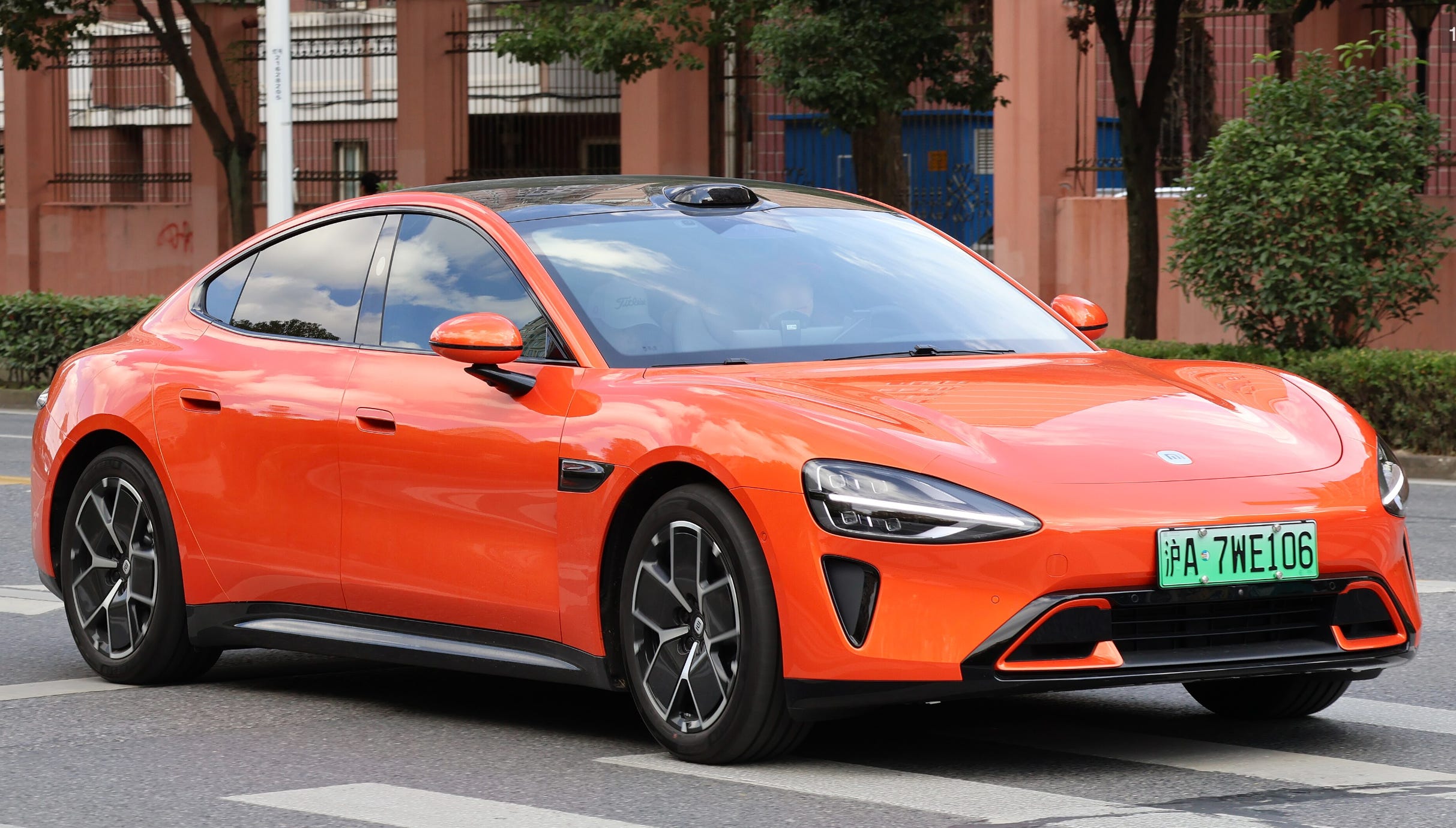
If you need more evidence that the US’s protectionist auto-industry policy is myopic and dumb, look at yesterday’s WSJ story by Ryan Felton about how Americans are eagerly buying Chinese cars in Mexico and driving them across the border.
And why wouldn’t they? Chinese cars are now cheaper and better than American cars. So of course Americans want them.
Unfortunately, US policy, which both political parties have supported, uses massive tariffs to (try to) keep Chinese car companies out of the U.S. market.
In addition to depriving most American consumers of great, cheap cars that the rest of the world is going bonkers over, this policy is making it so American car companies are no longer forced to compete with the world’s best car companies.
Over the long term, this makes it likely that American car companies will fall even farther behind.
At first blush, protectionist policies may sound smart and patriotic — they (temporarily) protect American companies and jobs! But, like it or not, we now live in a global economy in which companies compete on a world stage. As in the Olympics and some professional sports (tennis, for example), those who can’t compete… fail.
If the US were combining tariffs with a coherent industrial policy designed to buy time and incentivize American car companies to become more globally competitive — policies like the ones China used to vault past the US — some temporary protectionism might make sense.
Instead, we’re just shooting ourselves in the foot.
The US’s ban on Chinese cars destroys the incentive for American car companies to produce cars that are globally competitive. Although this may protect some jobs and shareholder value in the short term, over the long term it means American car companies will fall farther behind. It also means Americans will have to pay more for worse cars.
More from Perplexity (click for sourcing and links):
Please analyze whether protectionist trade barriers like the ones the US is using against China's car companies will help US companies long term.
In the long run, protectionist barriers like high tariffs and local-content rules are unlikely to make U.S. automakers globally competitive on their own; they mostly buy time, while imposing real costs on consumers and risking that the U.S. industry falls further behind in EVs and software-defined cars. Whether they “help” depends entirely on what the U.S. does with that time.
What tariffs are achieving now
Recent U.S. measures (100%+ tariffs, safety and data restrictions) have effectively kept Chinese EVs out of the U.S. market, even as those cars spread rapidly in Europe, Latin America, and other regions.
This has sheltered Detroit’s Big Three and other incumbents from direct price and feature competition from Chinese brands that are already highly competitive in cost and technology.
In that narrow sense, the policy “works”: it blocks imports and preserves domestic share in the U.S. market for now.
An illustration: the U.S. is currently one of the only major markets where Chinese automakers have almost no direct presence, despite China becoming the world’s largest auto exporter.
Why protectionism tends to hurt long‑term competitiveness
Economic and historical evidence suggests that prolonged protection, without aggressive restructuring and innovation, generally weakens industries rather than saving them.
Less competitive pressure: Shielded markets reduce the incentive to improve cost, quality, and product cycles; firms become reliant on policy rather than performance, which is already visible in critiques that American protectionism is “not translating into competitiveness.”
Complacency and policy dependency: Analysts warn that protected environments foster “policy dependency,” where companies lobby for continued shields instead of committing capital to risky EV/software bets.
Retaliation and lost scale: Trade partners often respond with their own barriers, which hurts U.S. exporters and shrinks the scale they need to amortize EV and software investments.
A Harvard analysis of recent U.S. protectionist moves argues that unilateral tariffs rarely deliver sustained benefits unless embedded in broader strategies and partnerships; otherwise, they erode growth and cooperation.
Specific effects in autos and EVs on U.S. automakers
U.S. carmakers have taken tens of billions of dollars in write-downs on EV programs and are retrenching around profitable ICE trucks and SUVs that mainly sell in North America.
Tariffs have not forced a cost or engineering breakthrough; instead, they have allowed a business mix that looks increasingly misaligned with global demand for affordable EVs and software-rich cars.
A Council on Foreign Relations report warns that if tariffs become a permanent crutch, North America could become “an isolated island of ICE vehicles in a Chinese‑controlled world,” missing the productivity, learning, and supplier ecosystems forming around EVs elsewhere.
On consumers and inflation
Tariffs raise the landed cost of imported vehicles and inputs, which dealers and OEMs pass through as higher prices; average new-car prices in the U.S. have climbed above $50,000, and protectionism is one factor limiting cheaper alternatives.
When affordable imports are excluded, consumers face fewer choices, must pay more or defer purchases, and lower‑income buyers are hit hardest.
On supply chains and innovation
Protection raises the cost of imported parts and materials, hurting downstream manufacturers and making U.S.-made cars less competitive abroad.
Historical experience shows that firms behind tariff walls invest less in technology than those exposed to open competition, unless governments pair protection with strict performance and innovation requirements.
What “help” could look like instead
Most serious policy work now emphasizes that tariffs can at best be a temporary shield, not a strategy.
For barriers to contribute to long‑term health, they’d need to be combined with:
Time‑bound protection explicitly linked to performance metrics (e.g., cost per kWh, software feature cadence, manufacturing productivity).
Large, disciplined public support for R&D and scaling (battery plants, power electronics, software platforms), with sunset clauses and clawbacks rather than open‑ended subsidies.
Deep integration with allies’ markets (Europe, Mexico, Canada, Korea, Japan) to regain scale and learning effects, instead of broad-based tariffs that hit these partners too.
Policies that directly spur competition at home (e.g., easing entry, supporting new EV-only players, standardizing charging and software stacks) so incumbents face pressure even if Chinese firms are absent.
Without this kind of complementary strategy, the evidence points in the opposite direction: protectionism preserves a shrinking domestic island, raises prices, and leaves the industry more fragile when barriers eventually erode or new competitors enter via other routes (e.g., production in Mexico or Europe and re‑export).
Bottom line for U.S. auto
Tariffs and other barriers are buying time for U.S. automakers but are not, by themselves, making them cost‑competitive or technologically leading in EVs and software-defined vehicles.
Long term, sustained protection without aggressive restructuring, innovation, and allied cooperation is more likely to entrench high prices and technological lag than to build a resilient, globally competitive U.S. auto industry.
See also: The end of OpenAI and the AI bubble?
Thank you for reading Regenerator!