


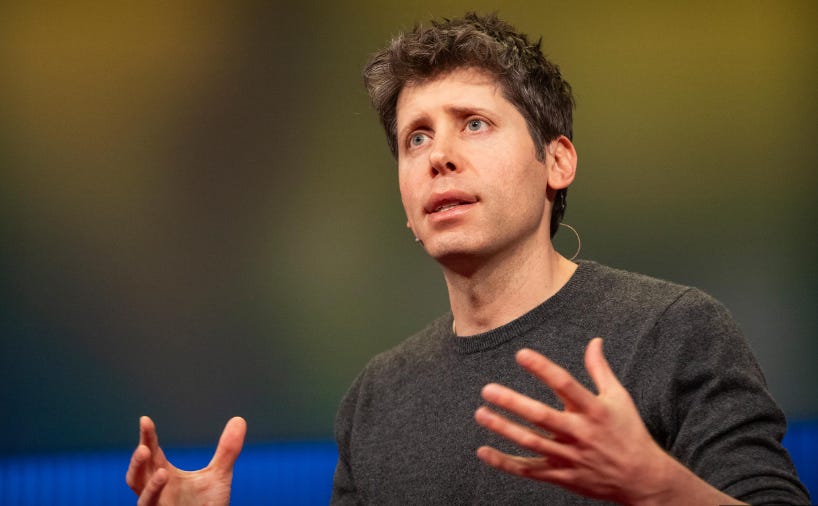
OpenAI is missing revenue and user projections, reports the Wall Street Journal.
In the Internet bubble, the first sign of the “bursting” came when the leaders — like Amazon.com — started missing projections.
So the question for the OpenAI community — and the much broader community fueling and feasting on the AI market bubble tied to OpenAI’s spectacular growth — is whether OpenAI’s problems are just OpenAI… or a sign that this first jaw-dropping era of AI euphoria and growth is coming to an end.
What’s going on at OpenAI
The WSJ’s lead story yesterday, by Berber Jin, reported that OpenAI “recently missed its own targets for new users and revenue.”
This news knocked the NASDAQ down a bit — not much — with companies exposed to OpenAI getting the worst of it.
The WSJ also said there’s a rift between OpenAI CEO Sam Altman and CFO Sarah Friar about the colossal amount of money OpenAI is committing to future data center deals, with Altman still going hell-for-leather and Friar pleading for caution.
OpenAI said the report of a CEO-CFO disagreement is a bunch of crap and that Altman and Friar are “totally aligned on buying as much compute as we can.”
That statement leaves plenty of wiggle room — OpenAI will almost certainly “buy as much compute as it can.” The key question is how much that is. And if the company is now missing projections, the answer is “less.” Thus, OpenAI-linked stocks dropped.
Also, there was no denial about the missed projections.
Specifically, the WSJ says, OpenAI missed its internal goal of reaching 1 billion weekly users (an eighth of the people on the planet) by the end of last year — and still hasn’t reported hitting this milestone.
It also missed its revenue targets last year and the early months of this year after Google Gemini and Anthropic caught up in capability and started taking market share.
No one ever caught up to Amazon
This “catching up” thing is big, by the way.
A few months ago, when a benchmarking firm announced that Google’s Gemini had surpassed OpenAI’s ChatGPT in some performance metrics, I suggested on Twitter that OpenAI was “in trouble.”
My logic was that many of those who remain euphorically bullish about OpenAI despite its almost-trillion-dollar valuation and woozifying cash consumption often justify their optimism by saying that “OpenAI is the Google or Amazon of AI.”
Maybe it will be.
But it’s worth noting three things:
The Google of the Internet — Google — didn’t even exist in the first Internet bubble wave. Back then, Yahoo and AOL were the “Googles of the Internet.” Everyone thought they would be the “Googles of the Internet” forever. Turned out, they weren’t.
The Amazon of the Internet — Amazon — grew like a bat out of hell in the last half of the 1990s, and its stock exploded to levels that now sound quaint but at the time were astonishing. Then growth slowed, and the stock dropped 98%.
No one ever “caught up” to Amazon. Even as Amazon’s growth slowed and stock tanked, it was still leaving Barnes & Noble, Wal-Mart, and all other challengers in the dust. Not so, OpenAI.
So, even if OpenAI does go on to become “the Amazon of AI,” it may still go through a brutal fight-for-survival period when the cash hose shuts off and it has to get profitable to fund itself. This period will be painful. And its valuation will collapse.
Amazon’s trouble started in Q4 1999 — when it missed “whispers”
At the end of 1999, the last euphoric year of the early Internet bubble, Amazon’s stock peaked in early December.
Then, in early January, 2000, when Amazon reported its Q4 results, the numbers were “very good but not spectacular,” according to a Merrill Lynch analyst named Henry Blodget, as quoted by Saul Hansell in the New York Times. (Thank you, Saul!).
Specifically, Amazon’s revenue fell short of Wall Street’s “whisper numbers.” And growth, while still otherworldly, slowed to a mere 157%. And Amazon lost more money than expected. (Couch change compared to AI losses, but meaningful in those days.)
There were, of course, excuses. Amazon had bought too much toy inventory to make sure customers got the toys they wanted in the company’s new toy store, I remember the story going. Amazon would learn from the experience and get better next year.
And Amazon did get better. But, in hindsight, that was the top.
The Merrill Lynch analyst, Henry Blodget, should have downgraded the stock and sold his own position. Alas, he didn’t.
Instead, he rode it down 98% until it almost went bankrupt a year later.
Fortunately, Amazon didn’t go bankrupt. It went on to become “the Amazon of the Internet” — one of the only leaders of that era to ever regain and then blow past its bubble high. In so doing, Amazon generated so much shareholder value it made up for the zeroes in all the other Internet bets that many Internet investors — including this one — incurred.
And maybe OpenAI will do that.
But maybe we’ve just gotten the reminder that all markets are finite, even AI. And that, in finite markets, valuation does eventually matter. (At least for companies not owned and run by Elon Musk.)
At some point, if OpenAI wants to make its shareholders money from here, it will have to generate, say, $20 billion of annual profit to justify its current ~$1 trillion valuation (50X earnings).
(For perspective, Amazon generated $77 billion of profit last year — 30+ years after its founding and after finally turning profitable in the early 2000s. So, it’s possible. On the other hand, AOL and Yahoo generated almost nothing.)
And given that OpenAI is expected to burn at least another $200 billion of cash before it starts generating cash, that will require a major change in the company’s financial trajectory. Especially now that its growth is slowing and it’s missing revenue and user projections.