


Hello, everyone! My apologies for the fallow stretch. I’ve been working on another novel. I’ll get cracking again here early next year. All best to all of you for the holidays.
Let’s speculate about what’s really going on at CBS…
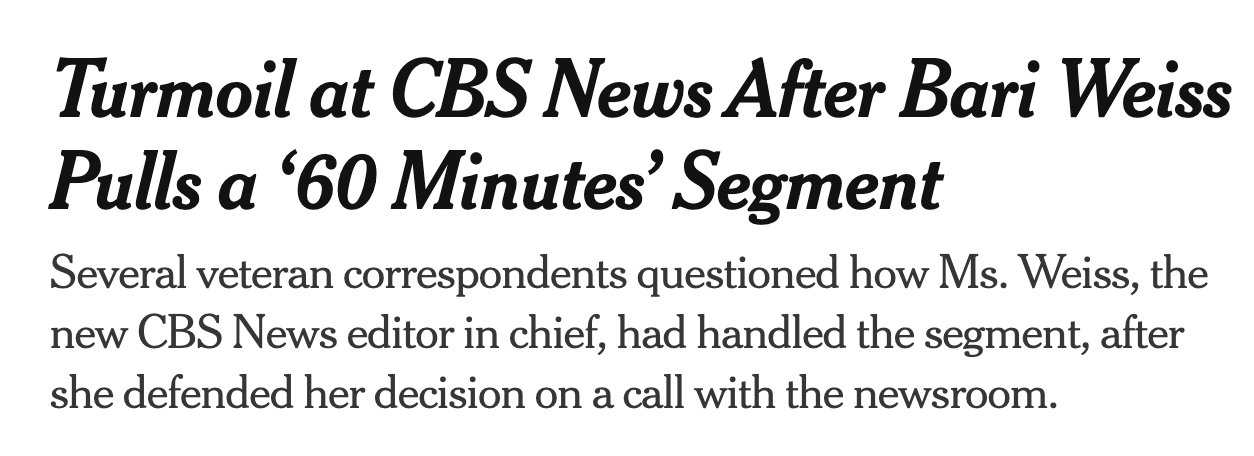
CBS’s new Editor In Chief Bari Weiss was hired by new owner David Ellison to make CBS’s news sensibility more… centrist. And to transform the product and organization so it is no longer dependent on linear TV (which is dying).
Bari needs to send a message that she’s serious about making these changes.
Bari needs to send the editorial sensibility message not just to CBS staff, but to David Ellison and to the country’s loudest CBS critic, Pres. Trump.
In sending this message, Bari must show that she is willing to piss the old guard off and, then, weather their criticism. She also knows that she will likely have to make some high-profile leadership changes.
You can make high-profile leadership changes by firing high-profile leaders. You can also make them by putting the leaders in a position where they feel they have to quit in protest. Having leaders quit is easier and cheaper than paying them severance, maybe getting sued, etc. And if they quit loudly, they’ll amplify your message.
Ideally, you also want to send your message without sacrificing your integrity.
So, why did Bari Weiss decide to spike (or hold) the 60 Minutes story about Pres. Trump’s favorite off-shore gulag (CECOT)?
Because she’s a Trump toadie and David Ellison or the White House ordered her to? (David Ellison is trying to buy Warner. Pres. Trump has said he will be involved in the decision, so Ellison has good reasons to suck up to Pres.Trump).
I doubt it.
I bet Bari decided to spike (or hold) the story because she saw an opportunity to kill two birds with one stone:
Send the message to the newsroom, David Ellison, the White House, and media critics that she’s serious about shifting CBS’s editorial sensibility to the right.
Improve a story a bit — with “improve” being in the eye of the beholder.
Folks in the newsroom are understandably appalled by the perception that Bari is a Trump toadie — and that, therefore, by association, they are Trump toadies.
But they also, presumably, want to keep their jobs.
After all, despite the inexorable decline of linear TV, jobs at 60 Minutes are still among the most prestigious and best-paid journalism jobs on Planet Earth.
So 60 Minutes staffers need to register their protest… without going so far as to quit. That’s why they complained but are not streaming out the door. (Which would be fine with Bari, by the way. And not just because it will help her change the editorial sensibility. To survive in the digital era, CBS is going to have to radically cut costs).
Now, maybe the newsroom and other critics are right that the reason Bari nixed the CECOT story is that the White House complained or Ellison ordered her to. Or maybe it was that Pres. Trump himself complained.
More likely, imho, Bari saw the chance to kill those two birds — send the message and improve a story.
As evidenced by her high-profile exit from the left-leaning New York Times, as well as her building the more centrist (but still fact-based) Free Press, Bari Weiss’s editorial sensibility is to the right of CBS’s.
Those on the CBS staff with a more left-leaning sensibility may not like Bari’s sensibility, but, well, she’s now their boss.
Anyway, Bari may well think the story would benefit from the White House perspective. So, she, too, may be acting with integrity.
(Many Americans — me, for one — think it’s abominable to send people to gulags without due process. Many other Americans — including those in the White House — think it’s “tough” and “strong.” The latter Americans might appreciate having that perspective in the story.)
So what happens next?
The newsroom will hope that its high-profile denouncement will cow Bari and get her to back off. And, even if not, by registering its protest, the newsroom will have kept its own integrity.
Bari, meanwhile, will hold fast. She has sent her message. She has the support of her boss. She is doing exactly what she was hired to do.
Bari is also probably hoping that some high-profile newsroom leaders will quit in protest. Because, if they quit, 1) they’ll be gone, and Bari can replace them with her own people, 2) everyone else will be even more on notice that change has come.
If the leaders don’t quit, meanwhile, they’ll at least tread more carefully, as will everyone else who wants to continue to work at 60 Minutes. Because jobs at 60 Minutes are still amazing journalism jobs.
In other words, what we’re seeing at CBS is a real-time lesson in the art of managing (and surviving) organizational change. Unfortunately for those who don’t like the changes — namely, the staff — Bari holds better cards.
Thank you for reading Regenerator!